Events
Events
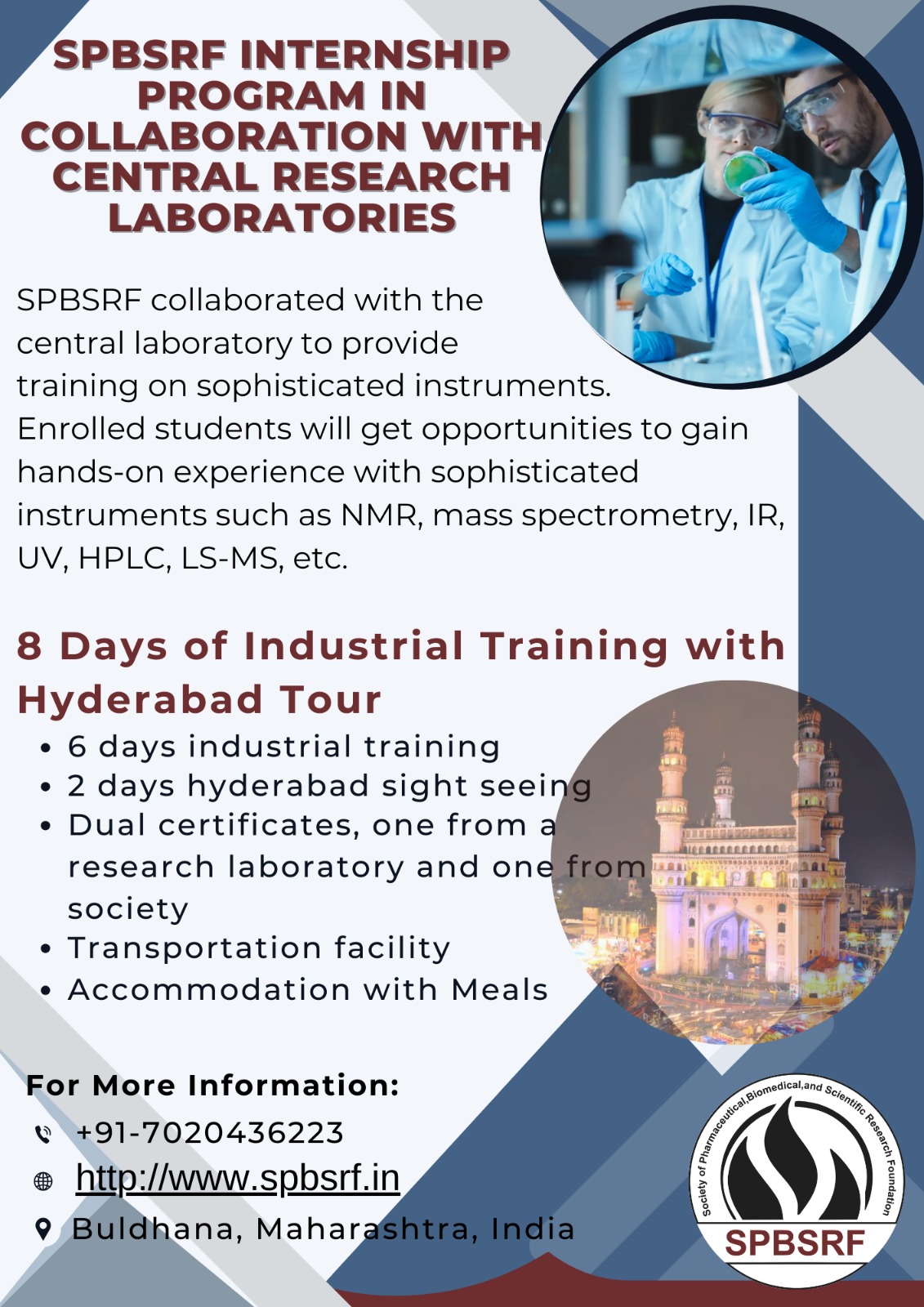
SPBSRF INTERNSHIP PROGRAM IN COLLABORATION WITH CENTRAL RESEARCH LABORATORIES
SPBSRF established a collaboration with the central laboratory to provide training on sophisticated instruments. Enrolled students will get opportunities to gain hands-on experience on sophisticated instruments such as NMR, mass spectrometry, IR, UV, HPLC, and LS-MS, etc.
Additionally, students will receive training on animal handling at the ICMR Laboratory. The program will also include an industrial visit and sightseeing in the concerned city.
SPBSRF believes that this collaboration will provide students with valuable exposure to the latest technologies and techniques. This course will include total 8 days program with accommodation and food. It will have complete transportation facility within the city.
- Dual Certificates, one from society and one from concern research laboratory
- Laboratory Animal Handling Training
- Hands-On Industry Experience :Industrial training provides students with practical exposure to pharmaceutical processes such as drug manufacturing, quality control, and regulatory practices. This real-world experience enhances their understanding of theoretical concepts and builds technical competence.
- Increased Employability and Career Opportunities : Certification courses validate a student’s skills and knowledge, making them more attractive to employers. These credentials improve their chances of securing jobs in pharmaceutical companies, research organizations, or regulatory agencies.
- Understanding of Industry Standards and Compliance : Students learn about Good Manufacturing Practices (GMP), regulatory guidelines, and industry norms, preparing them to work effectively in compliance-driven environments and ensuring they are industry-ready upon graduation.
- Skill Development and Professional Growth : Industrial training helps students develop a range of skills, including teamwork, communication, problem-solving, and the use of modern pharmaceutical technologies, which are critical for success in the workplace.
- Networking and Mentorship Opportunities : During training, students interact with industry professionals and experts, creating opportunities for mentorship and building valuable professional networks that can guide and support their career growth.
Benefits to the Students
Benefits to the Colleges/Institutes
- Enhanced Graduate Outcomes and Employability Metrics: Accreditation bodies like NAAC and NBA assess the employability of graduates as a key criterion. Industrial training certification courses equip students with industry-relevant skills, improving placement rates and strengthening the institute’s employability statistics, a vital aspect for securing a higher accreditation grade.
- Alignment with Accreditation Criteria on Industry Collaboration : Both NAAC and NBA emphasize collaborations with industries and practical exposure for students. Enrolling students in industrial training programs demonstrates active engagement with the pharmaceutical industry, showcasing the institute’s commitment to bridging academia and industry.
- Improved Program Outcomes (POs) and Course Outcomes (COs) : Certification courses contribute directly to fulfilling key program outcomes like technical competence, problem-solving skills, and lifelong learning. Institutes can highlight these achievements in their Self-Assessment Reports (SAR) as evidence of outcome-based education (OBE).
- Strengthened Research and Innovation Portfolio : Students trained in industrial settings bring valuable insights and innovative approaches to research projects. Institutes can use these contributions to showcase their commitment to fostering research and innovation, an important factor during accreditation evaluations.
- Positive Stakeholder Feedback and Brand Reputation : Industrial training enhances student satisfaction, leading to positive feedback during accreditation surveys and stakeholder evaluations. It also boosts the institute’s reputation as a forward-looking, industry-aligned institution, a factor that can influence peer and societal perceptions considered in accreditation processes.
- Enhanced Practical Knowledge and Skill Development : Industrial training bridges the gap between academic learning and real-world applications. Students gain hands-on experience with modern pharmaceutical technologies, processes, and regulatory practices, which strengthens their practical knowledge and skillsets.
- Improved Employability and Career Readiness : Certification courses provide students with industry-recognized credentials that enhance their resumes. These certifications validate their expertise, making them more competitive in the job market and better prepared for roles in pharmaceutical production, quality control, regulatory affairs, and research.
- Exposure to Industry Standards and Best Practices : Industrial training introduces students to current Good Manufacturing Practices (cGMP), compliance requirements, and the operational standards followed in the pharmaceutical sector. This knowledge ensures they are aligned with industry expectations and ready to contribute effectively.
- Networking Opportunities with Industry Professionals : During training, students interact with professionals from pharmaceutical companies, fostering valuable connections that can lead to mentorships, internships, and job opportunities in the future.
- Increased Academic and Research Insights : Exposure to real-world challenges in pharmaceutical production and research enhances students’ ability to understand and analyze complex problems. This not only benefits their academic projects and theses but also prepares them for advanced research roles in the future.
spbsrf@gmail.com OR nationalsecretary@spbsrf.in; Ph: +91-7020436223;
+91-9699252427.